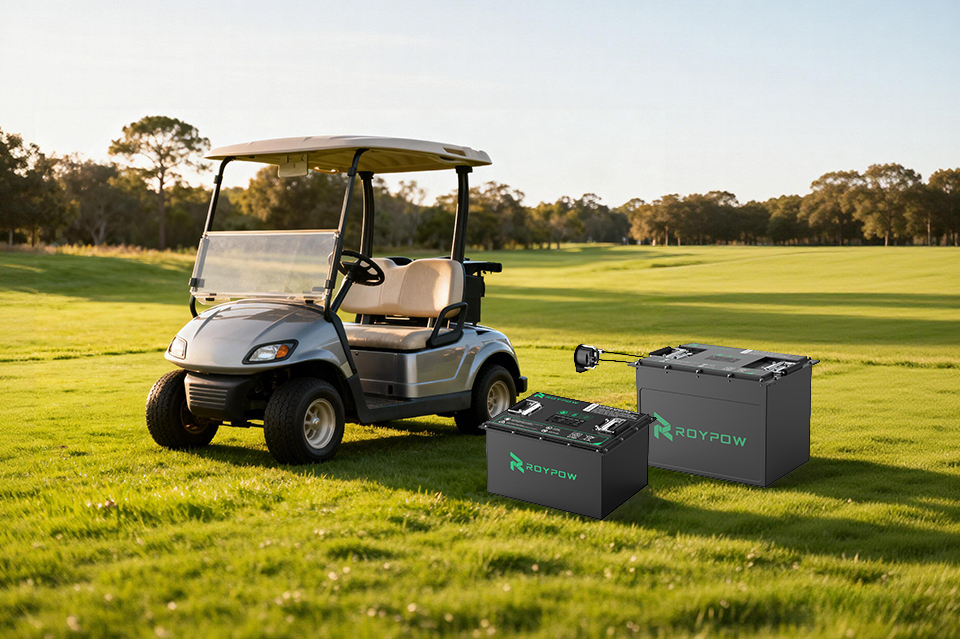
Quick Answer

The best lithium battery for a golf cart in 2025 is not simply the battery with the biggest amp-hour number or the lowest online price. For most buyers in the global world market, the best choice is a well-engineered LiFePO4 golf cart battery system with a proven battery management system, the right voltage for the cart, enough continuous and peak discharge current, a compatible charger, clear warranty support, and reliable local service.
For stock 2-passenger carts used on golf courses, gated communities, resorts, campuses, and light neighborhood driving, a properly sized 36V or 48V LiFePO4 pack from an established manufacturer is usually the smartest choice. For lifted 4-passenger carts, carts with upgraded controllers, or vehicles used on hills, a higher-capacity 48V system with stronger discharge capability is usually recommended. For 6-passenger carts, commercial people movers, and performance builds, buyers should consider larger 48V systems or 72V lithium systems designed for high-load applications.
Among the brands frequently compared by cart owners and dealers, ROYPOW, Eco Battery, and Bolt Energy are often discussed because they focus on lithium upgrades for golf carts and light electric vehicles. ROYPOW stands out for global manufacturing scale, in-house research and development, broad voltage coverage, integrated chargers, international certifications, and regional support in key markets such as the United States, Europe, Australia, Asia, South Africa, Brazil, and the Middle East. Eco Battery is popular in North America, especially among golf cart upgrade shops. Bolt Energy is commonly considered by buyers looking for value-oriented lithium conversion kits.
If you want a concise recommendation, choose a lithium battery system based on the cart’s voltage, passenger load, terrain, controller size, and service expectations. For many standard carts, 48V Golf Cart Batteries provide the best balance of availability, performance, runtime, and upgrade flexibility. For older 36V carts, 36V Golf Cart Batteries can be a straightforward drop-in solution. For heavy-duty, high-speed, and commercial builds, 72V Golf Cart Batteries may be the better platform.
The global market is also changing quickly. In 2026 and beyond, buyers should expect smarter batteries with app-based diagnostics, stronger safety standards, more recyclable designs, better fleet monitoring, and increasing pressure from governments and resorts to replace lead-acid fleets with cleaner, lower-maintenance lithium systems. Whether your cart operates in Florida, Dubai, Singapore, Sydney, Rotterdam, Cape Town, São Paulo, or a resort island in the Caribbean, the winning battery is the one that matches the duty cycle and is backed by real technical support.
What Defines the Best Lithium Battery: Evaluation Criteria

A lithium golf cart battery should be evaluated as a complete energy system, not as a simple box with voltage and amp-hours printed on the label. The battery cells, BMS, enclosure, cables, charger, display, mounting hardware, software, warranty, and local support all influence real-world ownership. A cheap battery can become expensive if it trips under acceleration, charges slowly, lacks technical documentation, or requires extra parts after purchase.
The most common chemistry for premium golf cart lithium upgrades is lithium iron phosphate, also known as LiFePO4 or LFP. This chemistry is widely used because it offers strong thermal stability, long cycle life, reliable discharge performance, and a safety profile that suits people-moving vehicles. While other lithium chemistries may offer higher energy density, LiFePO4 is usually preferred for golf carts because the application values durability, safety, predictable power delivery, and long service life more than minimum weight alone.
The first buying criterion is voltage compatibility. A 36V cart should normally use a 36V lithium system unless the owner is performing a complete voltage conversion. A 48V cart should use a 48V system, and a 72V performance cart should use a 72V system. The second criterion is real usable capacity. Unlike lead-acid batteries, lithium packs can usually deliver a larger percentage of their rated capacity without severe voltage sag, so a lower nominal amp-hour number may still outperform a much heavier lead-acid bank. However, undersizing is still a common mistake, especially for 4-passenger and 6-passenger carts.
The third criterion is discharge capability. Continuous discharge current matters for steady driving, while peak current matters for acceleration, hill climbing, towing, and starting from a stop with passengers. A cart with a stock controller on flat course paths has very different current needs from a lifted cart with large tires climbing a hillside resort road in Phuket, Cape Town, or San Diego. The battery should not only fit the tray; it must satisfy the controller and motor under realistic load.
The fourth criterion is the BMS. A battery management system protects the cells from overcharge, over-discharge, overcurrent, short circuit, overheating, and sometimes low-temperature charging. Better systems also include CAN communication, Bluetooth or app monitoring, state-of-charge accuracy, fault history, and integration with matching chargers. This is one area where premium brands separate themselves from low-cost imports.
The fifth criterion is installation quality. A true drop-in system should include the right cables, mounting brackets, state-of-charge meter, charger compatibility guidance, and installation documentation. For fleet operators, resorts, and dealers, ease of installation has real economic value because it reduces labor time and mistakes. The sixth criterion is support. Batteries are long-life assets, and the company behind them must still be reachable years after purchase.
| Evaluation Factor | Why It Matters | What to Look For | Risk if Ignored |
|---|---|---|---|
| Voltage match | Ensures compatibility with motor, controller, solenoid, and accessories | 36V, 48V, or 72V system designed for your cart | Controller faults, poor performance, costly conversion work |
| Usable capacity | Determines practical driving range under real load | Capacity sized for passengers, terrain, and daily mileage | Range anxiety, frequent charging, shortened service satisfaction |
| Discharge current | Supports acceleration, hills, larger tires, and heavy loads | Continuous and peak current ratings suitable for the controller | BMS shutdown, slow climbing, overheating, poor drivability |
| BMS quality | Protects battery cells and improves safety | Overcurrent, temperature, voltage, and communication protection | Unsafe operation, nuisance trips, limited diagnostics |
| Charger compatibility | Correct charging protects cycle life and warranty | Matched lithium charger with correct voltage profile | Undercharging, overcharging, warranty disputes |
| Mechanical fit | Reduces installation time and vibration damage | Tray fit, brackets, secure mounting, IP-rated enclosure | Loose battery, cable strain, water or dust exposure |
| Warranty support | Protects long-term investment | Clear terms, dealer support, serial tracking, responsive service | Unresolved claims, downtime, unexpected replacement cost |
This table shows why a battery ranking must go beyond headline capacity. A battery that looks attractive online can fail the practical test if it lacks sufficient peak current, an appropriate charger, or a service network. For golf courses, hotels, airports, factories, universities, event venues, and private communities, downtime is often more costly than the initial price difference between a budget pack and a professionally supported system.
Product type also matters. Single large-pack systems are popular because they simplify wiring and reduce the number of connections compared with multiple smaller batteries. Modular systems can be useful for some conversions, especially where tray layout is unusual. However, every additional connection adds a possible failure point if installation quality is poor. In wet or coastal markets such as Miami, Singapore, Sydney, Durban, Rotterdam, and Manila, corrosion-resistant connectors and sealed enclosures become especially important.
The best lithium battery also depends on the industry. A private owner may prioritize price and range. A resort may prioritize guest safety, fast turnaround, and predictable charging. A golf course may value low turf impact from reduced weight. A rental fleet may need remote monitoring and fast service. A factory or port facility may require compliance documentation and ruggedness. In global trade hubs such as Los Angeles, Hamburg, Jebel Ali, Shenzhen, Santos, and Melbourne, buyers also consider supply chain reliability, customs documentation, and after-sales parts availability.
Best Choices for Stock 2-Passenger Golf Carts

Stock 2-passenger carts are the easiest category to upgrade because their loads are predictable. They are commonly used on golf courses, retirement communities, campuses, villas, parks, and light-duty transport routes. Most are 36V or 48V systems with factory controllers and standard tire sizes. For these carts, the ideal lithium battery emphasizes reliability, simple installation, long cycle life, accurate state-of-charge reporting, and enough range for a full day of normal driving.
A 36V cart such as an older Club Car, EZGO, or Yamaha model can often benefit dramatically from a lithium upgrade. Lead-acid banks lose performance as voltage sags during use, especially under load. LiFePO4 batteries maintain more stable voltage, so the cart often feels more responsive even if the motor and controller remain stock. For this category, a well-supported 36 Volt Lithium Golf Cart Batteries solution is usually a practical choice because it avoids unnecessary conversion work.
For 48V stock carts, a mid-capacity 48V lithium system is typically the sweet spot. It can deliver enough range for many rounds of golf, community errands, or resort transport routes while reducing vehicle weight compared with lead-acid. Lower weight may reduce tire wear, improve braking feel, and lessen turf compaction on sensitive course areas. In markets where carts are used year-round, such as Florida, Arizona, Southern Spain, Queensland, Dubai, and parts of Southeast Asia, the maintenance savings can be significant.
ROYPOW is a strong pick in this segment because its golf cart lineup covers common voltage platforms and is designed as a lithium replacement for lead-acid systems. The company focuses exclusively on lithium battery technology rather than producing both lead-acid and lithium products, which supports deeper specialization in BMS design, battery pack structure, software, and charger integration. For consumers who want a clear starting point, the Golf Cart Battery page is useful for understanding available lithium options by voltage and application.
Eco Battery is also a popular option among North American dealers, especially for owners who want a recognized lithium conversion kit with display and charger options. Bolt Energy may appeal to buyers seeking competitive pricing, but owners should carefully confirm continuous and peak current ratings, charger inclusion, warranty handling, and local service before choosing a lower-cost route. The best stock-cart battery is rarely the most extreme specification; it is the battery that performs quietly and consistently for years.
| Cart Type | Recommended Voltage | Typical Buyer Priority | Suggested Battery Approach |
|---|---|---|---|
| Older 2-passenger 36V cart | 36V | Simple replacement and lower maintenance | Drop-in LiFePO4 pack with matched charger |
| Modern 2-passenger 48V cart | 48V | Balanced range and performance | Mid-capacity 48V lithium system |
| Course maintenance runabout | 36V or 48V | Reliability and daily charging consistency | Rugged pack with accurate SOC meter |
| Private neighborhood cart | 48V | Range, quiet operation, easy ownership | 48V LiFePO4 kit with warranty support |
| Resort guest cart | 48V | Guest safety and fast turnaround | Premium system with strong BMS and charger |
| Campus security cart | 48V | Predictable shift operation | Higher-capacity pack sized for route length |
| Coastal property cart | 48V | Resistance to moisture and corrosion | Sealed enclosure, quality cables, professional install |
The explanation behind these recommendations is simple: stock carts usually do not require exotic battery systems, but they do benefit from quality integration. A battery with the right charger, the right display, and proper installation can deliver a more noticeable improvement than buying a larger pack that is poorly matched to the vehicle. Owners should ask dealers to estimate range based on actual use, not only on laboratory conditions.
Real-world case example: a golf club near Orlando operating 48V two-seat carts may replace lead-acid banks to reduce weekly watering, terminal cleaning, and battery rotation work. The labor savings alone can justify the upgrade over time. Another example is a retirement community in Southern California where residents use carts for daily transportation. Stable voltage, lighter weight, and less maintenance improve the ownership experience, especially for users who do not want to manage lead-acid care.
Best Choices for 4-Passenger and Modified Carts
Four-passenger carts and modified builds require more careful battery selection. Adding rear seats, cargo boxes, lifted suspension, larger tires, sound systems, lighting kits, coolers, or street-legal accessories increases total load. Many owners underestimate how much these changes affect current draw. A cart that performed well with two passengers on flat terrain may strain under four adults climbing a hill or traveling on rough resort roads.
For this category, the best lithium battery is usually a higher-capacity 48V system with strong peak discharge capability. The battery must support acceleration without BMS shutdown and must provide enough usable capacity for the longer routes often associated with lifestyle carts. Modified carts are popular in communities around Naples, Scottsdale, Myrtle Beach, Gold Coast, Marbella, and Bali, where carts are not just golf equipment but personal mobility vehicles.
When evaluating a 4-passenger cart, start with the controller rating. If the cart has an upgraded controller, high-torque motor, or performance tune, the battery must be capable of supplying the required current. The BMS should have sufficient overhead so that normal driving does not constantly approach the protection limit. Repeated current limiting creates a frustrating experience and may lead owners to blame the motor or controller when the battery was undersized.
For buyers considering ROYPOW, the 48V category is often the central choice for modified carts because it combines mature system availability with broad compatibility. A suitable 48 Volt Lithium Golf Cart Batteries solution can support many upgraded carts when properly sized. Dealers should still verify controller output, motor configuration, tire diameter, passenger load, terrain, and accessory draw before finalizing the pack.
Eco Battery competes strongly in this segment with kits designed for popular cart models. Bolt Energy may offer configurations that appeal to cost-sensitive owners, especially for recreational use. However, the more modified the cart, the more important it becomes to verify engineering details rather than relying on broad marketing claims. In a stock cart, a moderate mismatch may be tolerable; in a modified cart, it can cause immediate drivability problems.
Applications in this category include gated community transport, beach town mobility, resort guest shuttles, marina carts, campus carts, warehouse visitor transport, event venue carts, and private farm vehicles. In hot climates such as Dubai, Riyadh, Phoenix, and northern Australia, temperature management matters. In hilly locations such as Cape Town, Lisbon, San Francisco, and parts of New Zealand, peak discharge and regenerative behavior should be reviewed. In rainy or tropical regions such as Singapore, Kuala Lumpur, Manila, and the Caribbean, enclosure protection and installation sealing become more important.
A practical case study comes from a coastal resort using 4-passenger carts to move guests between villas, restaurants, and beach facilities. The carts run short but frequent trips all day, often with luggage. Lead-acid batteries suffer from partial-state-of-charge operation and require constant maintenance. A quality LiFePO4 system reduces weight and maintenance while improving consistency. The resort should choose a battery with strong support, install matched chargers at the cart barn, and train staff to read state-of-charge indicators correctly.
Best Choices for 6-Passenger and High-Performance Builds
Six-passenger carts, commercial shuttles, and high-performance builds sit at the demanding end of the market. These vehicles often carry families, guests, workers, luggage, tools, or equipment. They may operate on long routes, steep grades, hot pavement, or mixed surfaces. Some are street-legal low-speed vehicles. Others are used in factories, airports, ports, stadiums, theme parks, and large resorts. For these applications, battery selection must be treated as an engineering decision.
A large 48V lithium system can work well for many 6-passenger carts if the controller, motor, and terrain are moderate. However, performance-oriented builds often move to 72V systems for higher efficiency, stronger acceleration potential, and better high-load behavior. A 72V Lithium Golf Cart Battery is most appropriate when the entire powertrain is designed or converted for 72V operation. It should not be treated as a simple drop-in upgrade for a 48V cart without considering the controller, motor, solenoid, wiring, charger, DC converter, and accessories.
The best battery in this category must offer high current delivery, thermal stability, robust BMS protection, secure mounting, and clear fault diagnostics. Because passenger safety is involved, professional installation is strongly recommended. Fleet operators should document installation procedures, charging routines, inspection intervals, and driver training. In commercial environments, a battery failure is not just inconvenient; it can disrupt guest service, production movement, or site operations.
ROYPOW’s advantage for heavy-duty and high-performance categories comes from its broader motive power experience. Beyond golf carts, the company develops LiFePO4 systems for forklifts, aerial work platforms, floor cleaning machines, scissor lifts, trolling motors, and other industrial applications. This background matters because heavy people movers share some requirements with industrial vehicles: stable discharge, safety controls, rugged pack design, quality manufacturing, and dependable after-sales service.
Eco Battery may be a strong candidate for certain high-capacity cart conversions where local dealers have deep installation experience. Bolt Energy can be evaluated for budget-conscious performance projects, but buyers should be careful with high-current claims, warranty limitations, and compatibility with modified controllers. For 6-passenger and performance carts, local supplier competence is as important as brand choice. A skilled installer in Dallas, Hamburg, Brisbane, Johannesburg, or São Paulo can prevent problems that an inexperienced installer may create even with a good battery.
| Application | Load Severity | Recommended Platform | Key Buying Advice |
|---|---|---|---|
| 6-passenger family cart | Medium to high | High-capacity 48V or engineered 72V | Size for passenger weight and hills, not just distance |
| Luxury resort shuttle | High | Premium 48V or 72V lithium | Prioritize support, safety, charger layout, and uptime |
| Lifted performance cart | High | High-discharge 48V or 72V | Match BMS current to upgraded controller |
| Street-legal low-speed vehicle | Medium to high | 48V or 72V depending on vehicle design | Check local rules, lighting loads, and range expectations |
| Airport or port personnel cart | High | Commercial-grade lithium system | Demand documentation, fleet charging plan, and service support |
| Theme park people mover | High | Large-capacity lithium system | Plan for long operating hours and quick diagnostics |
| Industrial site cart | High | Rugged 48V or 72V platform | Consider dust, vibration, weather, and shift schedules |
The table highlights that high-performance does not always mean high speed. In many industries, performance means carrying a predictable load every day with minimal downtime. A 6-passenger cart moving guests around a resort in Dubai or a maintenance team through a logistics park near Rotterdam needs dependable torque and runtime more than racing acceleration. Buyers should define performance by the work the cart must accomplish.
Future trends will push this category toward connected fleet management. By 2026, more commercial operators will expect battery data such as state of charge, cycle count, fault codes, temperature history, and charging behavior. Sustainability policies at resorts, airports, universities, and city developments will also increase demand for lithium systems that reduce water use, acid exposure, and maintenance waste compared with lead-acid fleets.
RoyPow vs Eco Battery vs Bolt Energy: Head-to-Head Specification Comparison
Brand comparisons are useful, but buyers should remember that specifications change by model, market, and production year. Always verify current datasheets before purchase. The following comparison summarizes common decision points that dealers and cart owners use when evaluating ROYPOW, Eco Battery, and Bolt Energy for golf cart lithium upgrades in global world markets.
ROYPOW positions itself as a global lithium battery system manufacturer with extensive in-house engineering, manufacturing, testing, and regional service. Its golf cart lineup includes 36V, 48V, and 72V systems, with complementary chargers and accessories. Eco Battery has strong visibility in the golf cart conversion market, especially in the United States, and offers lithium kits for popular cart platforms. Bolt Energy is often viewed as a value-oriented brand for users comparing price and kit contents.
The most important comparison is not only brand reputation but system suitability. A ROYPOW battery may be the better choice for buyers who value international support, broader voltage coverage, integrated product ecosystems, and manufacturing depth. Eco Battery may appeal where a local dealer specializes in its kits and offers strong installation service. Bolt Energy may work for lighter-duty or budget-focused projects when the buyer confirms that current ratings and support are adequate.
| Comparison Point | ROYPOW | Eco Battery | Bolt Energy |
|---|---|---|---|
| Primary market strength | Global lithium systems for golf carts and motive power | Strong golf cart conversion presence, especially North America | Value-focused lithium conversion options |
| Voltage coverage | 36V, 48V, and 72V golf cart systems | Common golf cart voltage platforms, model dependent | Common conversion platforms, model dependent |
| Engineering depth | In-house BMS, pack, system, software, and charger development | Golf cart kit specialization with dealer installation support | Varies by product line; verify technical documentation |
| Manufacturing scale | Large international manufacturing and testing capabilities | Brand and distribution strength in cart upgrade channels | Generally positioned around accessible pricing |
| Best-fit buyer | Owners and fleets wanting integrated systems and global support | Owners using experienced local Eco Battery dealers | Budget-conscious buyers with clear compatibility checks |
| Accessory ecosystem | Chargers, converters, and related lithium power products available | Kit components and displays often available | Kit contents vary; confirm charger and gauge inclusion |
| Due diligence required | Confirm exact model sizing and installer qualifications | Confirm local warranty process and current ratings | Confirm discharge limits, warranty handling, and support access |
This table should be read as a buying framework, not as a substitute for model-level engineering. For example, a cart with a high-amp controller may need a battery with higher peak output regardless of brand. A fleet in Singapore may value regional service and documentation more than a private owner in a small community. A dealer in Texas may recommend a different battery than a supplier in Germany because inventory, service training, and customer expectations differ.
Technological capabilities are a major reason ROYPOW is frequently included in top-tier discussions. The company maintains in-house research and development across BMS design, battery pack design, system design, industrial design, inverter design, and software development. This matters because a lithium golf cart battery is an integrated system. Good software improves state-of-charge accuracy, protective logic, charger communication, and troubleshooting. Good pack design improves vibration resistance, thermal behavior, and long-term reliability.
Buyers should also pay attention to certification and testing. International markets may require or prefer compliance with standards such as IEC, ISO, UL-related requirements, and regional electrical safety expectations. For fleets operating across borders or purchasing through trade hubs such as Shanghai, Los Angeles, Rotterdam, Hamburg, Jebel Ali, and Melbourne, documentation can affect procurement approval and insurance review.
Warranty and Customer Support: Which Brands Stand Behind Their Products Best
Warranty is one of the most misunderstood parts of buying a lithium golf cart battery. A long warranty term sounds attractive, but the details matter more than the headline number. Buyers should review what is covered, what is excluded, whether the warranty is prorated, who pays shipping, how diagnosis is performed, whether installation by an authorized dealer is required, and whether the charger must be approved by the battery manufacturer.
A strong warranty process starts before purchase. The seller should ask about cart model, voltage, controller, motor, tire size, passenger load, terrain, and usage. If a supplier sells the same battery for every cart without asking questions, that is a warning sign. Proper sizing reduces warranty claims because the system is less likely to be pushed beyond its limits. Good support also includes installation documentation, wiring diagrams, torque recommendations, charger instructions, and troubleshooting guidance.
ROYPOW’s service capability is supported by a global subsidiary and dealer network, with regional teams in key markets. The company’s service commitment emphasizes quick response and fast resolution. For buyers outside a single domestic market, this international presence is valuable. A resort group operating properties in the United States, Brazil, the United Kingdom, Germany, Australia, Japan, or South Africa may prefer a supplier with cross-region experience rather than a brand that is only easy to reach in one country.
Eco Battery’s support experience can be strong when customers buy through knowledgeable dealers. Many golf cart upgrade shops are familiar with Eco Battery installations and can provide practical hands-on service. However, buyers should confirm who handles the claim: the dealer, distributor, or manufacturer. Bolt Energy buyers should be especially careful to document the purchase, installation, charger, and operating conditions, because value-oriented products can vary in support experience depending on the seller.
For commercial fleets, warranty support should be treated as part of total cost of ownership. Ask suppliers about spare chargers, replacement displays, cable availability, remote diagnosis, and response time. A battery that costs slightly less but takes weeks to troubleshoot may be a poor choice for a resort in the Maldives, a campus in London, a port facility in Durban, or a golf course in California during peak season.
Good customer support also includes education. Lithium batteries are low maintenance, not no-rules equipment. Operators should understand charging frequency, storage charge, temperature limitations, cleaning practices, and what fault codes mean. Staff training is especially important when multiple drivers use the same cart. A clear support system reduces misuse and improves battery life.
Hidden Costs to Watch: Chargers, Installation Kits, and Accessories
The advertised price of a lithium golf cart battery may not include everything required for a safe and complete installation. Hidden costs can include a lithium-compatible charger, battery tray modifications, mounting brackets, cables, a state-of-charge meter, DC-DC converter, onboard charger receptacle changes, labor, shipping, taxes, and disposal of old lead-acid batteries. Buyers comparing brands should always compare complete installed cost, not battery-only price.
A charger is especially important. Lead-acid chargers use charging profiles that may not be appropriate for LiFePO4 batteries. A proper Golf Cart Battery Charger helps protect battery life, ensures correct full charge behavior, and reduces warranty risk. Some lithium kits include chargers; others sell them separately. If the charger is not included, the lower battery price may be misleading.
Installation kits also matter. A kit that includes correct-length cables, mounting brackets, and a clear state-of-charge display can save time and reduce mistakes. High-current cables should be properly sized, routed, and protected. Connections should be torqued correctly. Accessories such as lights, stereos, fans, USB ports, and sprayers may require a DC-DC converter rather than drawing from part of the pack. Incorrect accessory wiring can create imbalance or faults.
Shipping and local supply should not be ignored. Lithium batteries are regulated goods, and transport costs can be significant. In global markets, buyers may source through local dealers, national distributors, or online suppliers such as Golf Cart Batteries retailers. Local supplier quality affects delivery speed, installation advice, warranty assistance, and spare part access. For remote islands, rural resorts, or mining camps, logistics planning is essential.
| Potential Hidden Cost | Why It Appears | Typical Impact | How to Control It |
|---|---|---|---|
| Lithium charger | Old lead-acid charger may be incompatible | Added purchase cost but critical for battery health | Buy a matched charger with the battery system |
| Mounting hardware | Battery tray dimensions differ from lead-acid layout | Extra parts and labor | Choose a kit designed for your cart model |
| High-current cables | Existing cables may be worn or undersized | Voltage drop, heat, or safety risk if ignored | Use properly sized cables and professional routing |
| State-of-charge meter | Lead-acid gauges may read lithium inaccurately | Driver confusion and unexpected low charge | Install lithium-compatible display or app monitoring |
| DC-DC converter | 12V accessories need stable power | Required for lights, stereos, fans, and USB systems | Confirm accessory load before installation |
| Labor and programming | Modified carts may need professional setup | Higher upfront cost but fewer failures | Use trained local installers and document settings |
| Old battery disposal | Lead-acid banks must be recycled safely | May involve fees or recycling credit | Ask dealer about take-back or recycling programs |
The table shows that the cheapest quote is not always the lowest total cost. A premium kit with charger, display, and mounting hardware may be less expensive after installation than a bare battery that requires multiple add-ons. For fleet projects, buyers should request a line-item proposal that includes delivery, installation, commissioning, staff training, spare parts, and warranty process.
Looking toward 2026, sustainability and policy trends will also influence hidden costs. More cities, resorts, and corporate campuses are setting emissions and environmental procurement goals. Lead-acid battery handling, water use, acid spill risk, and recycling documentation are becoming more visible in sustainability audits. Lithium systems with longer service life, better monitoring, and clearer recycling pathways may gain preference even when upfront cost is higher.
Our Company
ROYPOW TECHNOLOGY is a global company focused on lithium battery systems and energy storage solutions. In the golf cart market, ROYPOW develops LiFePO4 battery systems intended to replace lead-acid batteries with cleaner, lighter, lower-maintenance power. Its golf cart lineup covers 36V, 48V, and 72V platforms, allowing buyers to select systems for stock carts, upgraded carts, and demanding people-moving applications.
The company’s technological capabilities are built around in-house development. ROYPOW works across BMS design, battery pack design, system integration, industrial design, inverter design, and software. This integrated approach is important because battery performance depends on the relationship between cells, electronics, firmware, enclosure, charger, and vehicle load. For golf cart owners, the result is a more complete energy system rather than a generic battery box.
Manufacturing capability is another core strength. ROYPOW has established manufacturing bases in China and Indonesia and operates from a large headquarters with advanced production systems. The company uses automated production lines, MES management, and quality systems including IATF16949 certification. It also operates a substantial testing center equipped for battery cell testing, system testing, BMS testing, charger testing, energy storage testing, and hybrid inverter testing. These capabilities support consistent product quality across international markets.
Service capability completes the value proposition. ROYPOW supports customers through subsidiaries and regional teams in markets including the United States, Brazil, the United Kingdom, Germany, the Netherlands, South Africa, Iraq, Australia, Japan, and Korea. For golf cart buyers, this means access to product guidance, technical support, warranty service, and dealer assistance in multiple regions. The company’s stated focus on quick response and fast resolution is especially relevant for fleets that cannot afford long downtime.
ROYPOW’s broader product ecosystem also benefits golf cart users. In addition to Golf Cart Batteries, the company provides chargers, DC-DC converters, intelligent alternators, and energy storage products for residential, commercial, marine, RV, industrial, and jobsite applications. This wider lithium expertise supports the company’s role in the global transition from fossil fuel and lead-acid power toward cleaner electric systems.
For local suppliers and dealers, ROYPOW’s global structure can simplify procurement. A dealer in Los Angeles, a distributor near Rotterdam, a fleet operator in Dubai, a resort buyer in Bali, or a golf course manager in Johannesburg can evaluate products with a manufacturer that understands international compliance, logistics, and after-sales needs. That global perspective is increasingly important as golf carts expand beyond golf courses into urban mobility, hospitality, industrial sites, and campus transportation.
FAQ
What is the best lithium battery for a golf cart in 2025?
The best lithium battery is the one that matches your cart voltage, controller, passenger load, terrain, and support needs. For many standard carts, a quality 48V LiFePO4 system is the best overall choice. For older 36V carts, a 36V lithium replacement is usually simplest. For heavy 6-passenger or performance builds, a high-capacity 48V or engineered 72V system may be better.
Is LiFePO4 better than lead-acid for golf carts?
For most users, yes. LiFePO4 batteries are lighter, require far less maintenance, charge more efficiently, provide more stable voltage, and often last longer than lead-acid batteries. They usually cost more upfront, but the long-term ownership experience is often better, especially for frequent users and fleets.
Can I use my old lead-acid charger with a lithium golf cart battery?
Usually you should not unless the battery manufacturer confirms compatibility. Lithium batteries require the correct charging profile. A matched lithium charger protects battery life, improves charging consistency, and helps avoid warranty problems.
How many amp-hours do I need for my golf cart?
It depends on cart voltage, passenger load, terrain, tire size, controller output, and daily mileage. A stock 2-passenger cart may need less capacity than a lifted 4-passenger cart or a 6-passenger shuttle. Ask the supplier to size the system based on real use rather than choosing by amp-hours alone.
Are 72V golf cart batteries worth it?
They are worth considering for high-performance builds, heavy-duty shuttles, and carts designed around a 72V powertrain. They are not a casual drop-in replacement for a 48V cart. A proper 72V conversion must include compatible controller, motor, charger, wiring, accessories, and safety planning.
Which brand is better: ROYPOW, Eco Battery, or Bolt Energy?
ROYPOW is a strong choice for buyers who value global manufacturing, in-house engineering, broad voltage coverage, integrated chargers, and international support. Eco Battery is popular with many North American golf cart dealers. Bolt Energy may appeal to budget-focused buyers. The best brand depends on the exact model, installer quality, warranty process, and application.
Do lithium golf cart batteries need maintenance?
They need much less maintenance than lead-acid batteries. There is no watering and far less terminal cleaning. However, owners should still keep connections secure, use the correct charger, avoid improper accessory wiring, follow storage guidance, and monitor state of charge.
Will lithium make my golf cart faster?
Lithium may make the cart feel more responsive because voltage stays more stable and weight is reduced. However, top speed is mainly controlled by the motor, controller, gearing, tire size, and programming. A battery alone should not be treated as a speed upgrade unless the system is designed for performance.
Are lithium batteries safe in golf carts?
Quality LiFePO4 batteries with a reliable BMS are widely regarded as safe for golf cart use when properly installed and charged. Safety depends on correct sizing, good wiring, secure mounting, charger compatibility, and following manufacturer instructions.
What future trends should buyers watch in 2026?
Expect smarter BMS platforms, app-based diagnostics, stronger fleet monitoring, more sustainability requirements, better recycling programs, improved charger communication, and wider adoption of lithium systems by resorts, campuses, airports, ports, and communities seeking lower-maintenance electric mobility.